
What is the Most Safe Search Engine in 2025?
In 2013, for the first time ever, a presidential administration treated news reporting like a crime, and a reporter like a criminal suspect.


In seeking a search warrant, the FBI, under Barack Obama, called Fox News’ reporter James Rosen a “criminal co-conspirator,” even though he was not charged with any crime.
Agents monitored Rosen’s movements in and out of the State Department. They searched his personal emails and combed through his cell phone records.
This sparked a rare occurrence in Washington DC: bipartisan outrage over what was termed “Obama’s war on journalism.”
Later, it was learned that Obama’s DOJ secretly spied on Associated Press reporters, obtaining two months’ (April and May 2012) worth of telephone records.
They acquired records for more than 20 different phone lines associated with the news agency — including reporters’ cell, office, and home lines — that affected more than 100 staffers.

“The Obama administration,” The New York Times editorial board wrote at the time, “has moved beyond protecting government secrets to threatening fundamental freedoms of the press to gather news.”
The result was during the Obama administration, the Department of Justice brought charges under the Espionage Act against eight people accused of leaking to the media — Thomas Drake, Shamai Leibowitz, Stephen Kim, Chelsea Manning, Donald Sachtleben, Jeffrey Sterling, John Kiriakou and Edward Snowden.
Finally, in 2020, the Justice Department inspector general revealed serious issues with the FBI’s applications to the secret Foreign Intelligence Surveillance Court to wiretap former Donald Trump campaign adviser Carter Page.

“The FBI is committed to working with the Court and DOJ to ensure the accuracy and completeness of the FISA process,” then FBI Director Christopher Wray responded.
The Court responded back: “Much of that information was inconsistent with, or undercut, the assertions contained in the FISA applications that were used to support probable cause and, in some instances, resulted in inaccurate information being included in the applications,” their report stated.

Although Page was never charged with a crime, these serious issues from the Obama-Biden Administration proved how dishonest, ruthless, and dangerous they could be.
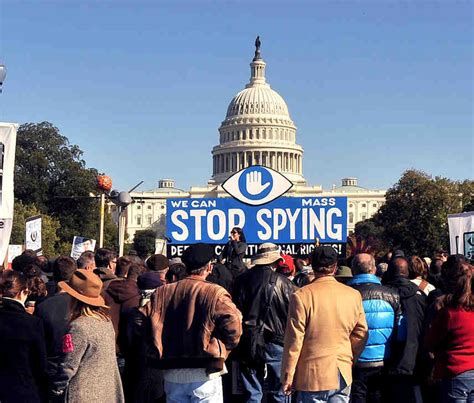
Today, after four years of a corrupt Joe Biden term in the White House, influenced significantly by Obama, Americans have a strong right to express serious concerns about government spying on citizens…especially on the Internet.
Enter Internet Searches
Google has 89.66% of the global market share of Internet search engines. Bing accounts for 8.88% of the market share on desktop devices worldwide.
Google’s revenue last year surpassed $196 billion, and they process approximately 6 billion searches per day.
Yandex (from Russia) holds third place with 2.53%, followed by Yahoo at 1.32% , DuckDuckGo with .82% and Baidu (China) at .72%.
Once the #1 ‘search engine’ in the world, Yahoo is now just a shell of itself. Its index is powered by Bing and it’s owned by Apollo Global Management, an asset management company.

According to Statista, Yahoo leads the ranking of the most compromised data records in selected data breaches worldwide.
Many people are frustrated and fed up with online censorship, particularly when trying to find specific information that was previously available.
Censorship can take many forms. With search engines today, censorship can come from filtering, manipulating, and/or blocking certain search results from appearing.
Occasionally, I am asked which search engine I use for research. I quit Google years ago simply because they can not be trusted.



Did you know that according to the United States Patriot Act, all internet servers and search engines physically located in the jurisdiction of the United States are obligated to disclose any information to the intelligence services?
Your personal data is at risk even if the servers and search engines don’t store any information: it is sufficient if the intelligence agencies read and store everything at the internet point of connection. This is one reason my second preference is Mojeek, based out of the United Kingdom.
I bypass Google, DuckDuckGo and other popular sites to use Brave Search, followed by Mojeek.
A major reason I don’t like the Googles, Yahoos, Bings, and DuckDuckGos of the world is because of how they direct searches to dishonest and propagandists sources such as CNN, The NewYork Times, MSNBC. I want real news!
In a perfect world, a search engine would provide helpful results while also respecting our privacy.
Metasearch vs. Search
Be aware, or beware, of the important issue of “metasearch vs. search.”
Most private search engines are technically metasearch engines. While a search engine “crawls” the internet and gathers its own results, a “metasearch” engine pulls its search results from other search engines, such as Google, Bing, and Yandex.
There are also a few search engines that fall in the middle by deploying their own crawler, but also pull results from other search engines.
Be Smart With Brave Search
Brave Search uses their own crawler that comes by the makers of Brave, which is a secure browser with built-in privacy that runs on open-source Chromium.
Unlike most of the other private search engines, Brave uses its own search index, rather than relying on Bing or Google.
They briefly describe the benefits of using Brave Search:
Brave Search is the world’s most complete, independent, private search engine. By integrating Brave Search beta into its browser, Brave offers the first all-in-one browser / search alternative to the big tech platforms. Brave Search beta is also available in other browsers, at search.brave.com.
Mojeek
Mojeek, from the UK, also uses its own crawler and is not dependent on others.
According to the Mojeek blog, the service surpassed 4 billion pages indexed in 2021.
In terms of privacy, Mojeek does well and claims to be the “first ever no tracking/privacy orientated search engine.”

It is important to know how censorship (and tracking you) affects many of the private search engines for two primary reasons:
● Censorship flows downhill. Many of the alternative and private search engines are nothing more than private proxies that deliver the same search results from the big players.
● This means that when Google and Bing (Microsoft) engage in censorship and search result manipulation, so will your alternative search engine that delivers those same results.
● Alternative search engines themselves are also engaging in censorship.
Recently the CEO of DuckDuckGo announced they will “down-rank sites associated with Russian disinformation.”
We can see both sides to the question of whether or not to engage in censorship given today’s geopolitical events, but in reality, I don’t want anyone telling me what is forbidden to read as this amounts to censorship, which is what many of us are trying to avoid after the experiences of the pandemic and Biden Administration.
An exception to this may be with independent search engines that deploy their own crawlers, such as with Mojeek, or Brave Search.
☆☆☆☆☆
To receive free email notification, when we post new articles like this, sign up below. Clever Journeys does & will not sell or share your information with anyone.
☆☆☆☆☆
IN GOD WE TRUST

Thanks for supporting independent true journalism with a small tip. Dodie & Jack

CLICK HERE for GREEN PASTURE BENEFITS

Use Code CLEVER10 for a 10% discount on Green Pasture products today!


☆☆☆☆☆


☆☆☆☆☆

By award-winning Texas author Cynthia Leal Massey.

See details here!
☆☆☆

CleverJourneys is on Gab.com

 Clever Journeys
Good article, Jack. As a tech and cybersecurity exec I fully support your conclusions and recommendations on browser selection.
Keep em coming!
Russell
Russell Swinney
rswinney@interstructure.netrswinney@interstructure.net
Ph: 214-619-2050
LikeLiked by 2 people
Thank you, Russell. Good work you do. I have several experts, including a first cousin, in that line of honorable work, as advisors or sources as needed. We appreciate what you do.
LikeLiked by 1 person
We use Freespoke as a search engine. I’ll check out Brave. Thank you for the behind the scenes information. 🙂
LikeLiked by 1 person
I tried Brave this morning, good choice.
LikeLiked by 2 people