
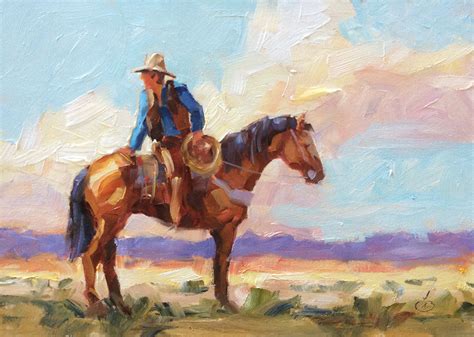
This is a true story about a 91-year-old cowboy who apparently dismounted his horse out on the range, lay down on the grass near a creek, crossed his arms over his chest, and peacefully died a cowboy’s perfect death – under the sky, with his boots on, and his hat over his face.
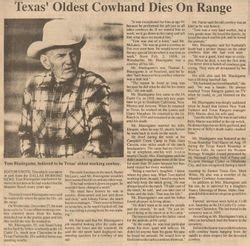
That man was a working cowboy for 73 years on the JA Ranch southeast of Goodnight, Texas. His name was Thomas (Tom) Everett Blasingame.
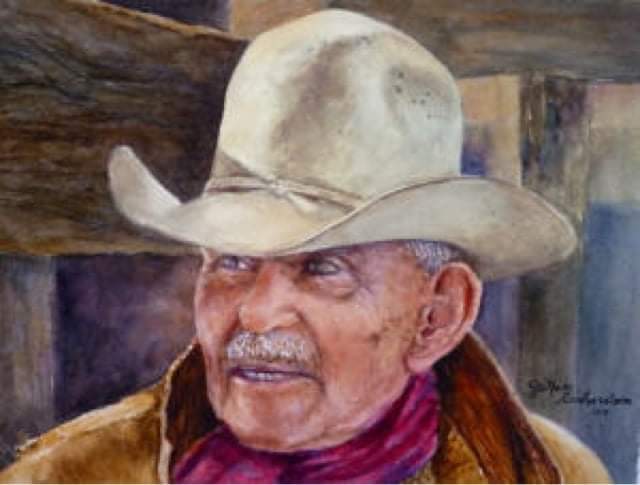
Thomas Everett Blasingame, Sr. (February 12, 1898 – December 27, 1989)
Tom Blasingame died the way he would have wanted, fellow ranch hands said at Tom’s funeral.
On December 27, 1989, the man believed to be Texas’ oldest working cowboy was found lying on his back by fellow cowhands at the JA Cattle Company Ranch near Clarendon, in the Texas Panhandle. His saddled horse was standing nearby. The cattle foreman on the ranch, Buster McLaury, said Blasingame wouldn’t have wanted his life to end any other way.

“If he had written it down on paper, he wouldn’t have changed a word. He must have known he was in trouble, dismounted and just laid down and died. There were no bruises or scratches, so he wasn’t bucked off, but he was riding a young horse he was training.”
Farrar said Blasingame’s job entailed looking after the cattle and horses, the fence and the windmill. He said the old ranch hand displayed outstanding qualities for a cowboy of any age.
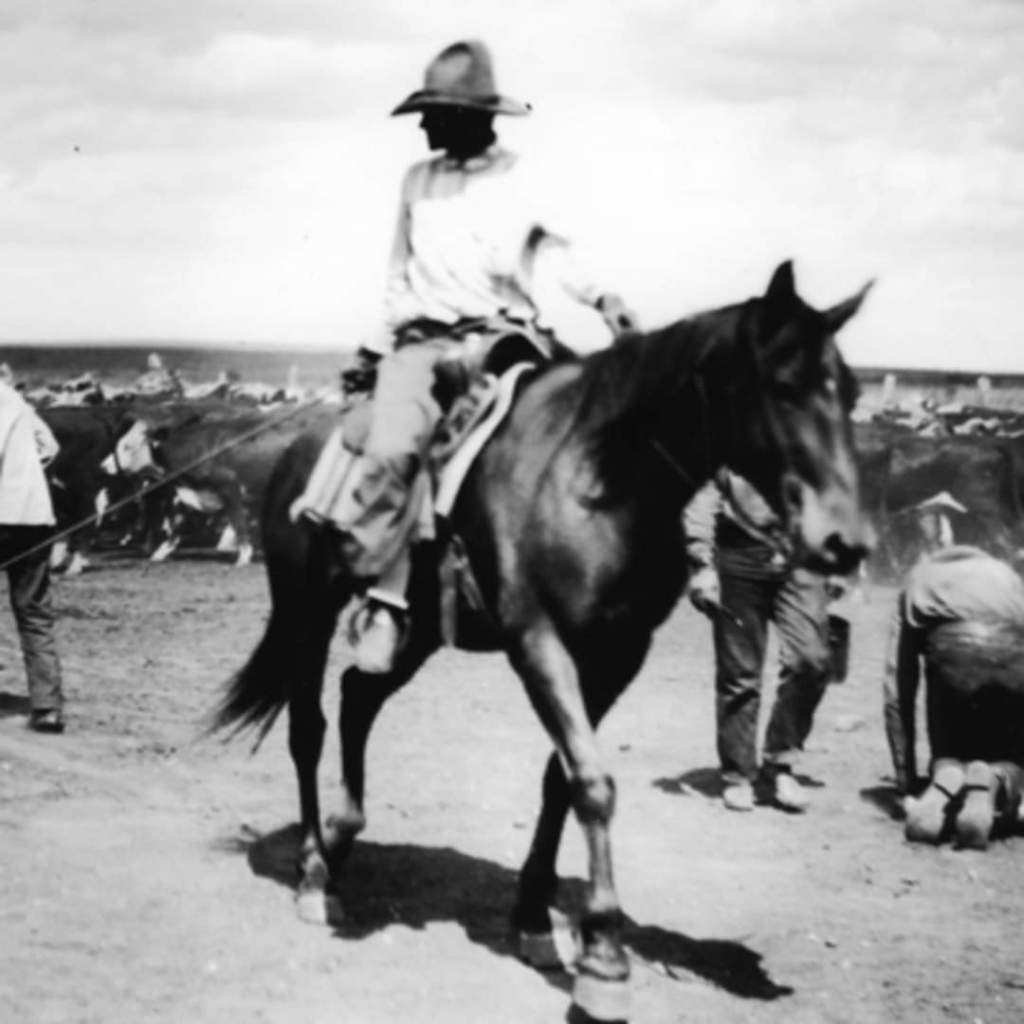
“It was exceptional for him at age 91 because he performed the job just as all other cowboys do. If we wanted him to work, we’d go down to his camp and tell him what days we needed him. Tom was one of a kind. He was as good a cowboy as I’ve ever seen here. He would never ask for any special favors when it was time to work.”
Peers rated him among the greatest horsemen in the Southwest.
Until his death, he continued to work 8 to 10 hours a day on the ranch. A few days before he died, he was out in sub-zero temperatures, chopping ice from stock ponds so the animals could drink.

Born February 12, 1898, in Waxahachie, Texas, he had been a cowboy all his life.
His son, Thomas E. Blasingame, Jr. of Hereford, Texas, said his father “had chosen to be a cowboy when he was a little kid.”
He first came to the JA Cattle Company Ranch in 1916, then left two years later to go to southern California, New Mexico, and Arizona. He returned in 1934 and remained at the ranch until his death.
Here are some quotes about his ranching experiences –
“I quit school to help my dad work, but I learned how to read and write of course. I just wanted to be outside all the time. Finally, when I was 18, I left home. I wasn’t happy with my family. I just wanted to get out of there. I couldn’t stay off a horse and wanted to get out where the big ranches was.”

“I headed west on a big iron-gray horse. I got him for $125 from a feller up the road. I don’t know how I saved that much money making two bits a day, but I finally did. I rode into the JA’s here in 1916 and didn’t have 50 cents in my pocket.
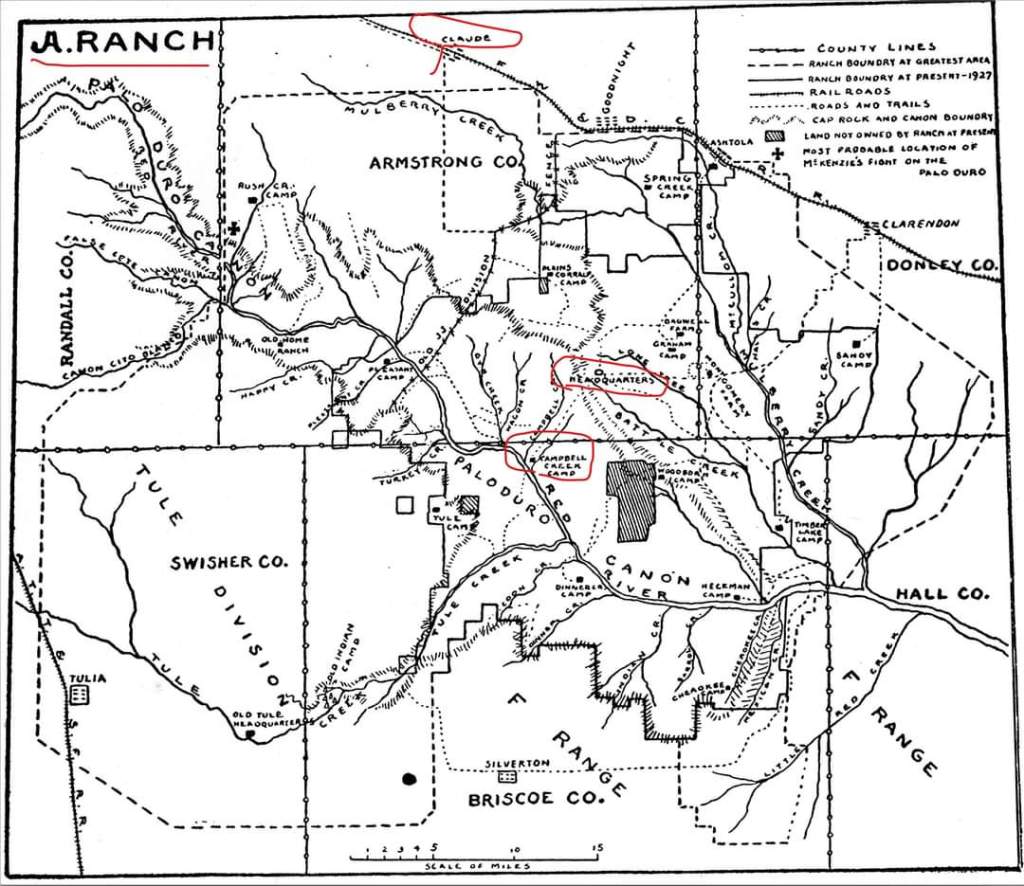
Back then, the JA ran 25,000 mother cows. I guess there was about 800 sections (of land). They had five chuck wagons out all the time, about 10 men to a wagon. By the time I came, the whole outside range was fenced. Inside, the ranch was all open country, but no more. Everything is fenced and cross-fenced with gates. I don’t like fences and I don’t like gates either.”
“I left the JA after two years to go to Arizona. I wanted to get to wilder country. Everybody wore six-shooters out there. I didn’t. I was just a kid. I never did see any gunfights, but I heard of ’em. They robbed a train while I was there and had a big shoot-out with the deputy sheriffs. One outlaw got his arm tore plum off with a high-powered Winchester. I seen him later at a dance. He’d dance with one arm.”
“I worked at the Double Circles in east central Arizona. It was a monster outfit. They didn’t know how big it was. We’d make big drives and throw the cattle together and brand and cut what we wanted to ship out. They had a big holding pasture in the center of the range where we’d put ’em, then we’d turn the others loose and brand ’em. We had plenty of wood in that country; so, it was easy to make a good fire.”

“We lived outside all the time. We had our bedrolls rolled up in a tarp. If it was raining, we’d just cover up with our tarps and sit there. We’d bathe in the river. It was pretty cold sometimes. We lived on beef and pinto beans. The meat kept fine outdoors. It was a lot better than this Frigidaire meat, you bet. Down on the desert outfits, they made lots of jerky. I’d eat it with biscuits if they was good, or I’d just eat it straight. You didn’t have many good bread cooks out in the camp. In the wintertime, we’d have them steaks for breakfast, and gravy. It was a pack outfit, so you didn’t get eggs or anything like that. It had to be stuff you could pack, but I never got tired of eating the same thing all the time.”

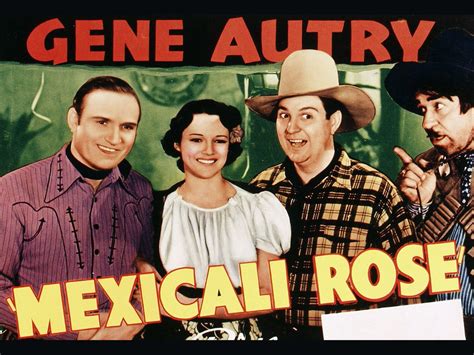
“At the Circles, we’d go to town on the Fourth of July and Christmas. Most of the cowboys would get drunk, but I never did take to that whiskey. Drinkers, they’re pretty disgustin’ when they get down and waller on the ground, mumblin’ and stumblin’ and vomitin’. Course, I’d go to the saloons. There was music going all the time. Them dancin’ girls would come out there onstage. You ever heard a song called Mexicali Rose? Well, I saw her. She was a beauty, all right, a tall, slim brunette. She sure could sing.”
“On Christmas, we’d hurry back to the ranch because that’s when they’d have them big dances. People would come from a hundred miles on horseback, women, children and all. They’d pack their good clothes on little mules. They’d stay around a week and dance all night and sleep in the daytime.”
“We’d lay around and run horse races, and a lot of ’em would play poker and kill time till night when they’d go to dancin’ again. Don’t ever think that people who lived way out like that couldn’t dance. Man, they could dance, waltz, one-step, square dance, you bet. Even them little kids could square dance. That was the prettiest thing to watch.”

“I stayed at the Double Circles for a couple of years. Then I worked some in New Mexico and California, and I moved back here two or three different times. I wanted to work for a lot of different places. That was the only way a poor man could see the country. I would just decide to quit and go.”
“You know, cowpunchers is pretty restless. Back then you could just throw your saddle over the fence and go to work for the next outfit. The Texas outfits paid $30 a month and the Arizona outfits paid $50. If I’d a had any sense, I could have been rich today, if I’d saved my wages. I always spent it or loaned it to some renegade that never did aim to pay it back. They’d drink it up and gamble it away. But heck, you were working with them, and you didn’t think nothin’ about it much.”
“I never did gamble or play poker or drink liquor. I didn’t even drink black coffee. That’s the reason I’m living today. I don’t smoke. I chewed a world of tobacco though, but I’ve quit that because my teeth wore out. I’ve still got a few left, enough to chew beef with.”
“Eleanor smokes, drinks coffee, cusses too, once in a while. I met her in ’32 when I came back to the JA. It was at one of their July Fourth dances. Her dad’s ranch was right next door. I don’t know why we got married. We just kind of wanted to. After we had our son and daughter, they’d come out and stay with me sometimes on the ranch. I always liked little children, and when I had some of my own, I loved ’em so much. I never did spank ’em. I let Eleanor do the dirty work.”
“I’ve read lots of books. Read the Bible a lot. I believe what the Bible says, but I don’t reckon I’m religious. Even if I was, I couldn’t go to church because I’ve got too much work to do.”
Thomas Blasingame was buried as he had asked, in a small ranch cemetery surrounded by a rock fence and barbed wire, looking out from a ridge overlooking the beautiful Palo Duro Canyons.
Eleanor Blasingame said her husband’s death had a greater impact on the other cowboys than she had ever seen.
“He was a good, kind man to everyone. When he died, it was the first time I’ve ever seen a bunch of cowboys just crying. They were all devastated by his death.”
About 400 people attended graveside services at the JA Cattle Company Ranch Cemetery. The last burial in the cemetery had been in 1899. He was buried in the ranch cemetery with cowboys who had worked the ranch since the 1870’s.
☆☆☆
IN GOD WE TRUST

Thanks for supporting independent true journalism with a small tip. Dodie & Jack
Have you lost a loved one? Find Griefshare sessions at a church near you.



CINDY LEAL MASSEY, TEXAS AUTHOR
CLICK: PARK LANE by Rebecca Taylor

 Clever Journeys
Good post, Jack, and a great story. On our last trip to Colorado Springs, on our way home after spending the night in Amarillo, we stopped in Goodnight and toured the ranch—a lot of history in that part of the world. My grandfather was a cowpuncher back in the early 1900s around the Weatherford, and Mineral Wells area, and was a frequent visitor to Hells Half Acre in Fort Worth before it got shut down by J. Frank Norris, the famous con artist preacher man. God Bless Texas.
LikeLiked by 2 people
Wow. My great grandfather James A. Morgan worked at Goodnight, among others. Most of his time was herding from Mexico to Kansas. Definitely know who Norris was.
LikeLiked by 2 people
We are going to Lincoln while in Ruidoso next week. I want to see where Billy The Kid got plugged by Pat Garrett.
LikeLiked by 2 people
You all have a good trip. Smart to go up there where it’s cool.
LikeLiked by 2 people
It’s cooler than here. 109 yesterday and 108 today. Ruidoso will be in the mid 80s.
LikeLiked by 2 people
What a cool story, Jack. And I love the photos. My brother-in-law has been a rancher all his adult life, but he does have a house to sleep in. I’ll have to tell him about Tom. 🙂
LikeLiked by 2 people
Is he in Texas.
LikeLike
Okay, you guys, as someone from “back East’, this is like looking in on a secret club, but what a great story and a simple, great man. Does living in South Dakota for almost 2 years when I was a kid and in Oklahoma for 2 count? I wore cowboy hats! To have a heritage like that, another treasure of the Real America, wow.
LikeLiked by 1 person
Absolutely counts!!!
LikeLiked by 1 person
I’m not sure why, but these types of articles get a surprising number of views/hits. I like to write them as a break from interviewing, research, and investigating politics.
LikeLiked by 1 person
Because, even the military gets entertainment, to keep morale up, and we most
definitely are the troops. Thanks! Oh we lived in Oregon, too. So I can be a semi-official Westerner!
LikeLiked by 1 person