
Gabby Vernoro Petito, 22, set out on a road trip with her fiance Brian Christopher Laundrie in a converted camper van on July 2, 2021 to tour National Parks across the United States.

They began at his family’s home in North Port, Florida. From there, they traveled to the Monument Rocks formation in Kansas, then headed for Colorado’s Great Sand Dunes National Park. Next, the pair went to the Zion, Bryce, and Canyonlands national parks in Utah.
Along the way, she started a van life blog to chronical their road trip. It was becoming popular with a growing fan base.
Behind the scenes, Brian was getting impatient and perhaps jealous with the online attention Gabby was garnering.
Suddenly, she disappeared in late August, and her family or readers did not hear from her in more than two weeks. Her mother began pleading for help finding her daughter.
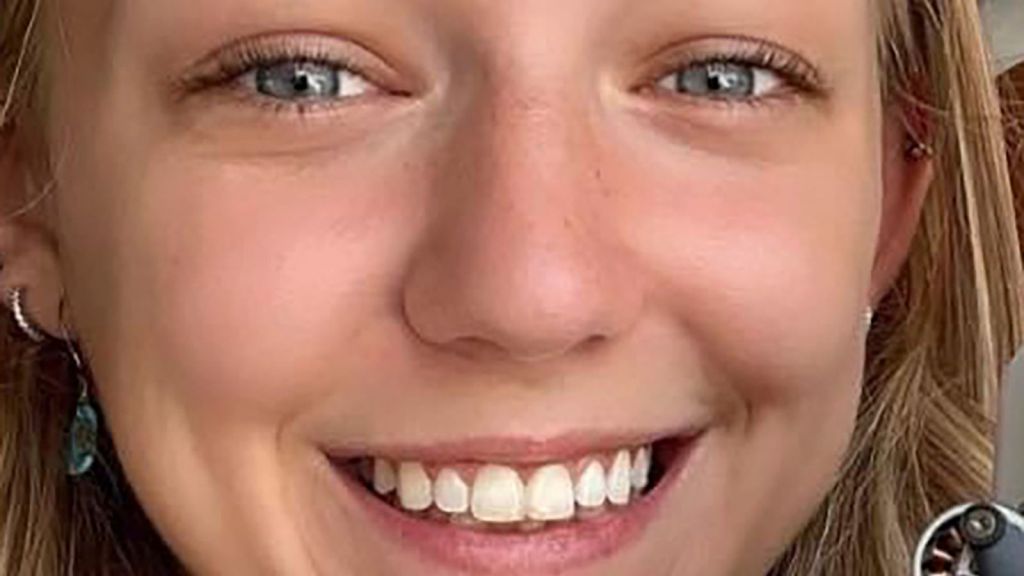
Nicole Schmidt, Gabby’s mother, said that the last verbal conversation she had with her daughter was on Aug. 25.
The trip was planned to last for four months and began on July 2, 2021, but Petito disappeared on August 27.

As the missing woman’s case started gaining national attention, Moab City, Utah Police Chief Bret Edge released a statement revealing that officers on Aug. 12 responded to an “incident involving Brian Laundrie and Gabrielle Petito.”
“On 08/12/21, MCPD officers were dispatched to a report of a domestic problem that had taken place near the Moonflower Co-op,” a police report revealed. “It appeared that a male and female had left the scene traveling north on Main in a white Ford Transit van with a black ladder on the rear after the male and female had engaged in some sort of altercation. It wasn’t clear, but I believe it was reported the male had been observed to have assaulted the female.”
Video Recording of Gabby questioned by police




She suffered from “severe anxiety,” the pair told the police, who categorized the incident as more of a “mental/emotional health ‘break’ than a domestic assault,” in their report.
The two said they were “in love and engaged to be married and desperately didn’t wish to see anyone charged with a crime.”
One officer was able to place Brian in a hotel room for the night, and Gabby stayed in the van. They agreed not to contact one another until the next morning, which would allow them to “reset their mental states.”
Neither one was seriously injured, and no charges were filed.

After an extended search of the area around his Florida home, Brian’s skeletal remains were discovered in Florida’s Myakkahatchee Creek Environmental Park on October 20. An autopsy revealed he died from a self-inflicted gunshot wound to the head.
On September 19, 2021, Petito’s strangulated body was discovered in Wyoming’s Bridger–Teton National Forest.
Lessons Learned
As a former private investigator and reporter who has interviewed and written about family domestic violence since the late 1970s, I’ve learned a lot about the predictable patterns of unhealthy relationships.
Being Neurolinguistic Programing (NLP) certified, I have also learned to recognize many of the tell-tale signs of abuse.
I am by no means a licensed therapist, social worker, police officer, or minister but I do know that far too many families are grieving, and I have tremendous empathy for everyone involved.
Many survivors might identify with at least some of the following insights.

Let’s examine important lessons this couple teaches us:
- Followers on social media saw a smiling, happy couple, full of love and wanderlust, setting out for a cross-country adventure while documenting all the joys of young life. In many cases, targets become very good at smiling through the pain.
- When the public was shown body camera footage captured by Moab City Police officer Daniel Robbins, (who pulled Laundrie and Petito over after the 911 call on August 12), some viewers assumed Petito was suffering from mental illness and Laundrie, while nervous, was the steadier of the two.
- Other viewers assumed both partners were equally at fault—the old “it takes two” myth that doesn’t really apply to most abusive situations.
- Some people even assumed Petito was the abuser and Laundrie was the victim.
- Healthy minded people tend to give others the benefit of the doubt, especially when someone is being accused of a negative act. Most of us can understand that mental illness is a difficult situation and can tax even the kindest most gentle of souls (and the people who love them). Unfortunately, in many cases, this thought pattern leads us to assume the victim is mentally ill or that the victim is to blame for an altercation.
- “Victim blaming” can happen even in the worst cases of abuse because we don’t see the longitudinal story unfolding. What we don’t see is that the target has managed to keep things together until she reached her threshold, at which time we may see her crying, yelling, or breaking down emotionally. By exhibiting those behaviors, many might assume the target is “unbalanced,” and it’s natural for us to feel as if the more stable person is more trustworthy.
- During boyfriend Laundrie’s conversation with the officers, he laughs and says, “She’s crazy.” Then he dismisses it as a joke.
- So officers start wondering if perhaps the target is “crazy,” the abuser plays the part of the poor, patient partner who has to deal with this irrational person. In the video of the officers’ interview, Laundrie mentions Petito’s anxiety and her OCD, painting her as an unstable partner.
- A typical abuser would be skilled at convincing people that he’s innocent, while in fact he’s been acting very differently behind closed doors, pushing his target to this point intentionally and feeding on her emotional break. Many abusers LOVE to see evidence that they’ve hurt their target. They LOVE to see their target in pain. For this reason, “breaking” the target is usually the goal from the start. In cases of abuse, it may take an abuser hours, weeks, months, or even years to break the target, but he won’t stop until he gets that reaction, and then he’ll point the finger and say, “See? She’s crazy. I’m just trying to keep her calm.” And then he’ll do it again. And again. And again.
- As a result, some people will buy into that false narrative. Even the target can be brainwashed to doubt her own truth. Which may be one reason we see Petito making many excuses for Laundrie’s behavior and taking the blame for everything.
- In contrast, the video shows Laundrie blaming Petito, insisting he never hit her and saying he was just trying to keep her calm. He’s charming. He comes across as the loving and loyal partner. He’s joking around with the officers and even gives one a fist bump in the end. All the while, his fiancée is at risk of being charged with domestic assault and possibly spending the night in jail.
- In the original 911 recording, it appears the responding officers were not fully informed of at the time: “I’d like to report a domestic dispute.” The 49 second audio recording continues as the caller says, “The gentleman was slapping the girl.” When the dispatcher asks him to confirm that the man was slapping the girl, the caller responds, “Yes, and then we stopped, they ran up and down the sidewalk, he proceeded to hit her, hopped in the car, and they drove off.”
- But long before the 911 call was made public, many survivors could already see through the spin playing out on the video footage. They easily recognized the “red flags” because these cycles become the norm for victims of long-standing abuse. Many targets eventually become conditioned to believe everything the abuser does is her fault. Covering for the abuser, accepting all the blame, trying harder to make the abuser happy—this warped reality becomes the only truth a target knows.
- Also, it seemed clear that Petito didn’t want her fiancé to be in any trouble. She’d rather pay the price and wanted to protect the man she loved. And because she probably believes he only acted this way because of her mood/behaviors/ anxiety/OCD/job, she didn’t want him to be blamed. This is also the norm in abusive relationships.
- The four responding officers (two of whom were park rangers) remained calm, they separated the couple, they interviewed them individually, they split them up for the night, they consulted the domestic violence shelter … many would say they did everything right considering the information they had at the time.
- After Petito was reported missing, many people expressed shock in response to the Laundrie family’s refusal to cooperate early in the investigation. Petito reportedly lived with the Laundrie family for more than a year. While most of us can certainly understand parents wanting to protect their son, most would agree they crossed a moral line when his fiancée went missing.
- But perhaps it goes deeper than that. Perhaps what we were seeing was a system of enablers who not only allowed their son to abuse Petito (which may have been a factor in her reported anxiety) but also a system of gaslighters who may have always been shifting the truth to keep Petito confused and make her believe she was the problem.
- It’s not a far stretch to assume Petito was caught in a system of abuse. And once a target is caught in that psychological web, it’s extremely difficult to see a way out. Reality becomes flipped.
- It’s also worth noting that Petito and Laundrie had been involved in various levels of a relationship since their teens. This is also commonly observed in dysfunctional partnerships.
- These immature relationships work beautifully when both partners grow together and mature emotionally. But when one wants to keep the other down, naïve, and under his control … and the other is growing, learning, and maturing … it doesn’t work.
- Petito told an officer that Laundrie didn’t think she could succeed with her travel blog. It seems clear that he didn’t believe in her and that he was trying to make her doubt herself.
- Throughout the conversation, he implied that he locked her out of the van because she wouldn’t calm down. But behind all that, it appeared he was upset because they’d spent too much time at a coffee shop with her working on her website when he wanted to go hiking. This suggests that because she wasn’t in the van when he was ready to leave, he lost his temper.
- In the moments that followed, the altercation became physical. Reportedly, Laundrie squeezed Petito’s face with his hand, cut her down verbally, and criticized her.
- Some would argue that this escalating abuse typically persists until the target reacts emotionally and/or physically. If this case follows the norm, Laundrie may have been trying to break her spirit, intentionally.
- Why? Again, if this case follows the typical situation, it would likely be because Petito’s focus wasn’t 100% on Laundrie. She had found this new job on social media that she enjoyed. She was succeeding at it, and it was allowing her to connect with other people.
- In a healthy relationship, the new job might be considered a positive opportunity for Petito. Especially considering Laundrie admitted they had very little money (not even enough to afford a hotel room to prevent his fiancée from going to jail). But in an unhealthy relationship, the abuser wants the target all to himself. And when that doesn’t happen, he can become increasingly violent.
- Petito had created this one little piece of her life that Laundrie couldn’t control, so if we’re looking at textbook patterns, perhaps her blog angered him. Perhaps he didn’t like all the attention she was getting on social media. Perhaps he punished her for it. And then a cycle developed. Even though she was doing nothing wrong by building a new career.
- The next thing we know, we have a missing person, a recovered body, a young man on the run, and several families destroyed. Too much grief to measure. And the truth is, it will happen again tomorrow, and the next day, and the next day, until we learn to recognize and respond to abusive situations in healthier ways.

When we see someone at her emotional end during a domestic dispute, we shouldn’t assume she’s crazy. We shouldn’t buy into the false narrative given by the abuser. We shouldn’t believe the cover-up story by the target who has been conditioned to carry all the blame and shame. And we shouldn’t assume they’re going to be okay.
Instead, we should all learn the difference between healthy and unhealthy relationships.
•We should learn to recognize the warning signs of abuse.
•We should engage in respectful, fact-based conversations about trauma bonds, abusive cycles, and emotional intelligence.
•We should be familiar with terms like gaslighting, hovering, love bombing, enabling, triangulating, and projecting.
•We should stop blaming targets and help them reclaim their truth.
•We should stop repeating the age-old myths that keep targets trapped in these dangerous and all-too-often deadly cycles.
•We should recognize that abuse crosses all barriers and can impact anyone regardless of gender, sexuality, ethnicity, nationality, religious affiliation, age, or socio-economic level.
•We should stop assuming these situations will get better in time.

Personally, I have never heard of even one abusive relationship that became healthier.
When an abuser is determined to destroy his/her target, he/she will not stop until that target is erased from this world or stripped from his/her life.
In many cases, he or she will walk away without any consequences, often taking the target’s finances, home, vehicle, reputation, or even his/her children with him.
For support, contact the Domestic Violence Hotline. From a safe phone, call 1-800-799-SAFE (7233) or text “START” to 88788.
☆☆☆☆☆
IN GOD WE TRUST
Thanks for supporting independent true journalism with a small tip. Dodie & Jack

Green Pasture Here!


Use Code CLEVER10 for a 10% discount on other Green Pasture products today!



CINDY LEAL MASSEY, TEXAS AUTHOR

Now Available CLICK Here!See more. Click here.

 Clever Journeys
Best comprehensive write-up on this subject I’ve ever seen. Just look at the change in her face as the relationship goes on, from innocence to misery. I was thinking, as I read this, that it sounded a lot like Charles and Diana. But she got away. It is absolutely true that an abuser like this one will just keep on, because the control and hatred drive them to own and destroy someone, body and soul, as if, at that point, you become forever theirs. So sick.
LikeLiked by 3 people
Some abusers are masters at manipulating people and projecting their evil (or mental illness) onto others.
LikeLiked by 2 people
[…] Lessons from the Murder of Gabby Petito & Suicide of Her Abusive Fiancé […]
LikeLiked by 2 people
I thought about what I said about Charles, and would like to add that I don’t think he’s basically that way. Probably he had a guilty conscience, and so he got mad, trying to hide everything; became cruel in doing so. Certainly he’s learned, but there were some aspects of abuse in the situation.
LikeLiked by 2 people
and people ask me how could i be single all my life, never found someone compatible enough, why should i settle, i am my own best friend, i rest my case, i have acquaintance friends who are married to strangers, love is and can be blind, this is so true, buyer be ware
LikeLiked by 2 people
I have many friends (even in their 60s, 70s & 80s) who never married & they are doing just fine. Thank you!
LikeLiked by 1 person