

Team Approach to Keeping Potential Attackers Off ‘Pathway to Violence’
A team of law enforcement and behavioral experts meet three times a week in Texas to prevent acts of mass violence similar to the tragic one that occurred at the Uvalde school in 2022.
In San Antonio, less than 80 miles from Uvalde, assembled around a large conference table, police detectives, fire investigators, mental health experts, federal agents, and others discuss and evaluate cases they believe could—if ignored—devolve into acts of mass violence.
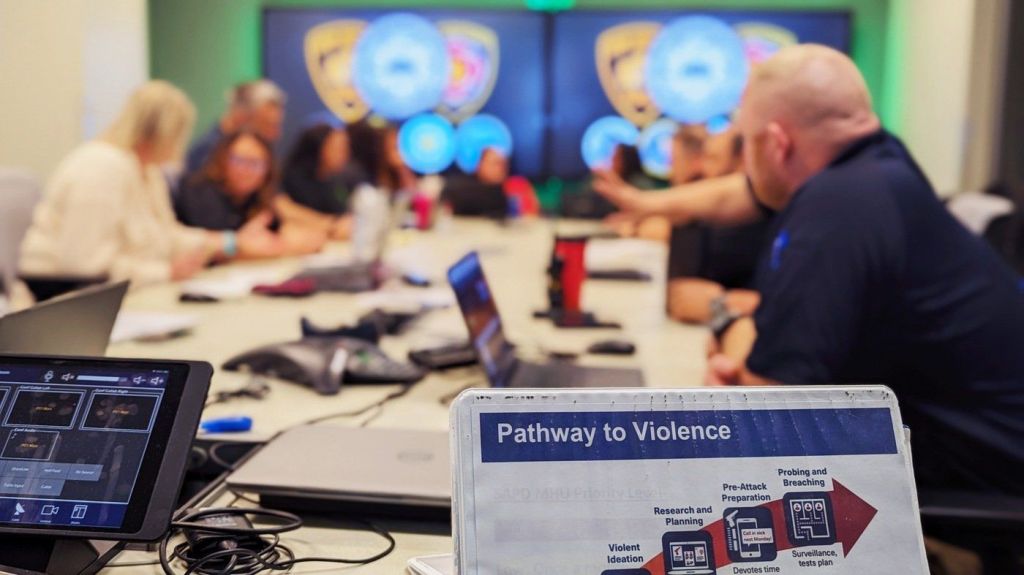
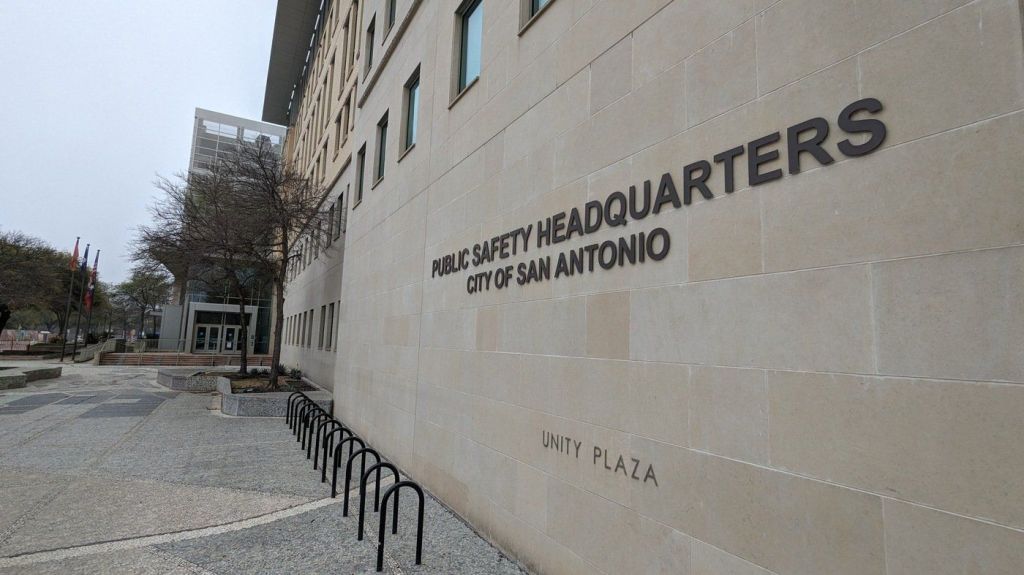
The Behavioral Threat Assessment Group, or BTAG, meets three times a week at the Southwest Texas Fusion Center, a high-tech intelligence hub inside San Antonio’s Public Safety Headquarters.
When a Texas teenager made vague threats on social media in 2022 glorifying the mass shooting in Uvalde—where a young man killed 19 students and two teachers at Robb Elementary School just months earlier—tips started coming in to law enforcement.
A police department investigator in Texas quickly developed a picture of the subject: a 19-year-old man who idolized the Uvalde offender, posted pictures of himself with weapons, and professed a desire to die in a shootout with police. A search of his home in late 2022 found no weapons. And he told the investigator, who works on a task force with the FBI’s San Antonio Field Office, that he had no plans to carry out a school shooting.

But the incident became a focus of a team of experts who continually assess known and emerging threats in the region. The Behavioral Threat Assessment Group, or BTAG, meets three times a week at the Southwest Texas Fusion Center, a high-tech intelligence hub inside San Antonio’s Public Safety Headquarters.
Drawing on their unique areas of expertise, team members collectively present and examine cases and debate how to proceed. After assessing their level of concern about a specific case, the team develops and implements strategies designed to manage the concern.
“Everything about threat assessment and building a management plan for somebody is about having all the pieces of the puzzle,” said Josh Thomas, a San Antonio Police Department (SAPD) detective who coordinates the BTAG meetings every Monday, Wednesday, and Friday.
The puzzle pieces are not just experts at the table but also the unique access they each have to their organizations’ current records and data. That could include court dates, behavioral assessments, criminal records, medical calls, and more. This multi agency approach also allows the team to incorporate resources available through each partner organization to divert subjects off a path to violence.
“Being able to get that right then and there is absolutely critical to what we do,” Thomas said.
“Everything about threat assessment and building a management plan for somebody is about having all the pieces of the puzzle.”
Josh Thomas, BTAG coordinator, San Antonio Police Department
The group’s threat assessment approach is based in large part on a model developed by the FBI’s Behavioral Analysis Unit (BAU), which has studied and produced research on mass shootings and similar acts of targeted violence and identified behaviors that often precede mass attacks.
BAU is part of the FBI’s Critical Incident Response Group (CIRG), which includes the Behavioral Threat Assessment Center (BTAC), a multi-agency federal task force focused on preventing terrorism and targeted violence through behaviorally based support, training, and research. In 2018, BTAC established the nationwide Threat Assessment and Threat Management Initiative, which later helped lay the foundation for BTAG in San Antonio.
In the case of the Texas man who idolized the Uvalde offender, no actionable crime had been committed when he was first interviewed. But the young man agreed to a mental health assessment and was admitted for treatment.
Providing information on mental health resources—and helping those in need get access to the appropriate resources—is a claimed central tenet of the San Antonio Police Department. When concerns involve a possible mental health component—about half of BTAG cases—sworn officers from SAPD’s Mental Health Unit are there to deliver needed resources.

“Our goal is to connect people on the mental health side to services because a lot of them don’t know how to get those services,” said Sandi Zimmerman, an SAPD officer. “My goal every day is to get them connected.”
Mass shooters spend time thinking about violence and they plan, prepare, and often share indicators before their attacks. Educating ourself on what to look for can be the key to preventing an attack of mass violence in our communities.
BTAG’s goal includes understanding where—and if—someone might be on a “pathway to violence,” a term referencing the behavioral arc that perpetrators of mass violence generally follow: from thinking about harming others to planning and attacking.

At any given time, the BTAG in San Antonio is managing hundreds of cases that are somewhere on that spectrum.
“It’s become a gold-standard for community-led threat assessment teams,” said Special Agent Sam Ukeiley, an FBI threat management coordinator in the San Antonio Field Office. A former profiler in BAU, Ukeiley helped an earlier iteration of BTAG formalize their process in 2019 and integrate BAU’s threat assessment and threat management approach.
“You make sure you’re addressing all the threats in an accountable and defensible manner, so nobody falls through the cracks at a minimum,” Ukeiley said. “That’s what it’s all about.”
It was, in part, that accountability model that alerted the BTAG to new concerning behaviors by the Laredo, Texas, man in late 2022. After being released from treatment, he posted a video clip on social media of himself driving past Robb Elementary, site of the mass shooting, and an image of a hand holding a rifle magazine.
On December 11, 2022, the man tried to buy a shotgun in San Antonio. When his application was delayed because he provided an incorrect home address, the FBI notified the local investigator, who arrested him on a state charge of making terroristic threats related to the Uvalde school shooting. The man was sentenced to jail, followed by a three-year period of supervised release. Post-release conditions will provide a structured reentry to society and enhance law enforcement’s options to monitor for concerning changes in behavior.
“You make sure you’re addressing all the threats in an accountable and defensible manner, so happy nobody falls through the cracks at a minimum. That’s what it’s all about.”
Sam Ukeiley, special agent and threat management coordinator, FBI San Antonio
The FBI has more than 130 threat management coordinators across 56 field offices around the country.
A news release from the FBI states that their “role is to evangelize to law enforcement partners and their own field offices how good threat assessment and threat management can help reduce the likelihood of mass attacks. BAU personnel point to San Antonio’s BTAG as a shining example of the benefits of working closely and continuously with multidisciplinary partners to manage threats.”
“They have these really thoughtful partnerships in place that give them more options when they have a complicated and concerning case with no clear path forward,” said Brad Hentschel, a BAU supervisory special agent/profiler. He likened threat management to a control panel where more is better—more ideas, more resources, more options.

“Do you have one or two buttons that are traditional law enforcement actions like interviews, searches, and arrests?” Hentschel said. “Or do you have a whole suite of buttons and levers and dials that can allow for much more refined or nuanced approaches to moving someone away from focusing on hurting a lot of people?”
“When you have so many people at the table it allows for new ideas to be presented because someone may see something from a different perspective. And that’s really beneficial.”
Sgt. Matthew Porter, BTAG supervisor, San Antonio Police Department
On a recent Monday morning, Josh Thomas, convened the BTAG meeting with about 20 team members seated around the “threat table” with laptops open. Several others dialed in remotely.
“We have two new ones for consideration today” he said. He briefed the new cases and several ongoing cases and then opened it up for discussion. For more than an hour, police, mental health providers, arson investigators, and SAPD’s in-house psychologist weighed in. When someone raised a question, someone else had the answer—if not immediately, then at their fingertips.
“It’s amazing being able to get the information real-time so that we can make decisions real-time,” Thomas said.

Sgt. Porter, the BTAG supervisor, said that’s the beauty of having strong relationships in place and having everybody at the table invested in seeing cases get resolved before they escalate.
“When you have so many people at the table it allows for new ideas to be presented because someone may see something from a different perspective. And that’s really beneficial,” Porter said. “It’s a lot of moving parts but everyone moves in the same direction. It’s solid. We have a really solid foundation.”
☆☆☆☆☆
IN GOD WE TRUST

Loralyn ‘Dodie’ & Jack Dennis
Thanks for supporting independent true journalism with a small tip. Dodie & Jack

Green Pasture Here!


Use Code CLEVER10 for a 10% discount on other Green Pasture products today!

CINDY LEAL MASSEY, TEXAS AUTHOR

DANGER CLOSE

Learn more Patriots:
Byrne’s DANGER CLOSE is available here.
☆☆☆☆☆

 Clever Journeys
A whole lot of good people dedicated to a good cause, working together to save lives. Prevention: an ounce is worth a pound of cure. I salute these people.
LikeLiked by 1 person